
Petrol and diesel prices were hiked by 60 paisa per litre on Monday, for the second day in a row, as State-owned oil firms reverted to daily price revisions after an 83-day hiatus. Petrol price in Delhi was hiked to Rs 72.46 per litre from Rs 71.86 on Sunday, while diesel rates were increased to Rs 70.59 a litre from Rs 69.99, according to a price notification of state oil marketing companies.

The fall in international oil prices notwithstanding, ONGC Videsh Ltd will not revise its pound 12.50 a share buyout of Imperial Energy Corp Plc as the acquisition priced UK-listed firm's in-place oil reserves at $2.5-3 per barrel.
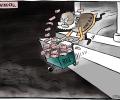
The windfall taxes on domestic crude oil production and fuel exports will generate close to $12 billion (Rs 94,800 crore) for the government in the remainder of the current fiscal while trimming profits of firms such as Reliance Industries Ltd and ONGC, Moody's Investors Service said Tuesday. On July 1, the government imposed windfall gain taxes on the export of petrol, diesel and aviation turbine fuel (ATF), and on the domestic production of crude oil. It has also mandated exporters to meet the requirements of the domestic market first.
The government said on Monday it is examining whether domestic petrol and diesel prices can be reduced in line with the fall in global crude oil prices.

After steep correction in valuations, these have turned attractive but upside will depend on diesel price rises and export-parity pricing.

The reduction in auto fuel prices today was the fifth cut in two months on back of softening global oil prices.
Retail prices of palm and sunflower oils are likely to drop by Rs 2 per litre, following a reduction in import duty by 10 to 12.5 percentage points effective Wednesday.

Foreign portfolio investors (FPIs) have net sold domestic shares worth over $10 billion so far this month amid a shift to China, which not only offers attractive valuations compared to India but has also announced several measures to support the economy and the stock market in recent weeks. If the trend doesn't reverse, this will be the first time that overseas funds will yank out more than $10 billion from Indian equity markets in a month.

Equity benchmark indices Sensex and Nifty settled lower for the sixth straight session on Monday due to heavy selling in bellwether stocks including HDFC Bank and Reliance Industries amid mixed trends in the global markets and outflow of foreign funds. Falling for the sixth consecutive session, the BSE Sensex tumbled 638.45 points or 0.78 per cent to settle at 81,050. During the day, it plummeted 962.39 points or 1.17 per cent to 80,726.06. The NSE Nifty slumped 218.85 points or 0.87 per cent to end at 24,795.75.

Remittances growth is muted due to "structural" reasons which will hamper consumption demand locally, a report said on Thursday. "...the muted external remittances growth is more of a structural issue than transitory," India Ratings and Research said in its note. India has been the largest recipient of remittances from its diaspora spread all across the world and received over $70 billion inflows last year. The agency argued that flows had started to moderate even before the COVID-19 pandemic outbreak, pointing out that as a percentage of gross disposable income, the share of remittances fell to 2.5 per cent in FY19 as against 3.5 per cent in FY10.

From the Sensex pack, Nestle, Tata Consultancy Services, IndusInd Bank, Asian Paints, Bharti Airtel, Tech Mahindra, UltraTech Cement, Kotak Mahindra Bank and Hindustan Unilever were among the major laggards. Tata Steel, JSW Steel, HCL Technologies, Axis Bank, Power Grid and Mahindra & Mahindra were among the gainers.
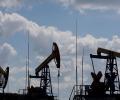
India's purchase of US crude oil has picked up in 2025 and could easily double their previous levels, government officials said on Wednesday. The surge comes in the wake of the then-incoming Donald Trump administration's announcement that it would consider hiking tariffs on a reciprocal basis, and pushed some countries, especially those with large trade surpluses with the US, to buy more of its energy.
India's crude oil imports from Russia fell for a second straight month in January to its lowest in 12 months but the nation's insatiable appetite for Russian crude remains for the long term, according to data from energy cargo tracker and industry officials. Russia supplied 1.2 million barrels per day of crude oil to India in January, down from 1.32 million barrels in December and 1.62 million barrels in November 2023, according to data from energy cargo tracker Vortexa. Russia however continues to remain India's top oil supplier, accounting for a little less than a quarter of 4.91 million barrels a day of oil that the world's third largest energy consumer imported in January.

The stubbornly high global crude oil prices are opening up a can of worms to heightened inflation risks and likely to disrupt government's fiscal maths along with deteriorating global financial conditions.

The last time these two indexes recorded a negative performance on a calendar year basis was in CY19.
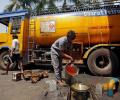
Investors shunned shares of oil marketing companies (OMCs) on Friday as they feared that the government's decision to cut retail prices of petrol and diesel could hurt the companies' profit margins in the near term. On Thursday, the government announced that OMCs will reduce pump prices of petrol and diesel after a record 22 months, making them cheaper by Rs 2 per litre in the national capital. The changes were effective from Friday.

'If nominal growth improves and earnings pick up, Indian stock markets could see a rally next year.'

The Reserve Bank of India (RBI) has started winding down its short position in the dollar forward book, after a gap of seven months, on the back of a softening dollar, while infusing funds via open market operations (OMOs) to counter the resulting liquidity drain.

From the 30-share Sensex blue-chip pack, Titan, Adani Ports, UltraTech Cement, Tata Consultancy Services, NTPC, Bharti Airtel, Tech Mahindra, Infosys, Hindustan Unilever and JSW Steel were the biggest laggards.

Some are treating the price correction as akin to a fiscal stimulus that could kick-start a new demand cycle in the economy.

The 30-share BSE gauge climbed 465.14 points or 0.80 per cent to finish at 58,853.07. During the day, it jumped 546.97 points or 0.93 per cent to 58,934.90.
.jpg)
The Reserve Bank of India sold dollars via state-owned banks around 62.3575 per dollar to contain the rupee's fall, traders said.

If crude prices have increased, retail petro product prices should go up.

For every rupee fall against the dollar, the under-recovery will increase by Rs 8,000 crore
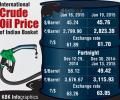
OPEC hopes lower fuel prices will stimulate more demand in the long run

India is the world's fourth-biggest oil consumer, importing four-fifths of its needs as its own output shrinks.

IOC and other state retailers had on September 16 raised jet fuel price by 2.5 per cent.
Privatisation of old oil fields to raise output and reduce India's import dependence was advised by the Economic Survey.
The current sky-high price of oil at $50 a barrel has been caused due to stockpiling by various countries, said Ged Davis, managing director, Centre for Strategic Insight, World Economic Forum, in New Delhi on Wednesday.

Stock markets snapped the four-day falling streak on Tuesday with the benchmark Sensex rebounding by 317 points on buying in auto and pharma shares amid a decline in retail inflation to a more than six-year low, nearing the RBI's comfort zone. The 30-share BSE Sensex climbed 317.45 points or 0.39 per cent to settle at 82,570.91. During the day, it jumped 490.16 points or 0.59 per cent to 82,743.62. The 50-share NSE Nifty edged higher by 113.50 points or 0.45 per cent to 25,195.80.

Investors' wealth on Monday surged Rs 4.21 lakh crore as markets bounced back after five days of fall. The BSE Sensex jumped 602.75 points or 0.76 per cent to settle at 80,005.04. During the day, it surged 1,137.52 points or 1.43 per cent to 80,539.81.

Wall Street-correlated stock markets are facing the risk of correction, as Christopher Wood, the global head of equity strategy at Jefferies, conveys to investors in his latest edition of GREED & fear. Rising crude oil prices, which are nearing $100 a barrel (Brent), pose a threat to the global central bank's battle against inflation and have led to a re-evaluation of its exposure to Indian stocks. "The potential for more US Federal Reserve (Fed) rate hikes, combined with the risk that monetary tightening finally bites as regards the economy, remains a risk for Wall Street-correlated world stock markets. "There is also the oil factor. This is why GREED & fear continues to believe the pain trade is down. "Areas in Asia, such as Indian midcaps, which have already done very well, are at obvious risk of some profit-taking," writes Wood.
Every time the Indian economy has faced headwinds due to international developments, the oil sector has played a crucial role, explains A K Bhattacharya.

The 30-share Sensex ended down 159 points at 27,425 and the 50-share Nifty closed down 24 points at 8,299.

The first to see price hikes will be soaps. In the past six months, domestic palm oil prices have increased by 46 per cent. Palm oil is a key input going into soaps.

The rupee depreciated 31 paise to an all-time low of 80.15 against the US dollar in early trade on Monday tracking the strength of the American currency and firm crude oil prices. At the interbank foreign exchange, the rupee opened at 80.10 against the dollar, then lost ground to quote at 80.15, registering a fall of 31 paise from the last close. On Friday, the rupee closed at 79.84 against the dollar.

Benchmark share indices opened lower on Monday, amid weak global cues, as investors turned cautious ahead of the US Federal Reserve stance on interest rate.

'With China falling out of favour, India is where investors see the demographic and digital dividend apart from the benefits of reforms playing out.' 'Your prime minister has also done a great job of sharing this story with the world.'
